
How to use this guide
Pick a topic from the dropdown. Each topic opens with the tip sheet: what to memorise, the formulas, and where the marks are. Then test yourself on the definitions before you open them, and go straight to that topic's exam questions.
- Study notes: read the tip sheet, then say every definition out loud before you open it.
- Quiz: a quick scored check per topic. Wrong answers come back as flashcards.
- Exam practice: real provincial questions. Choose a topic and a question set from the dropdowns. The question and its diagram open at every sub-question. Type your answer, press Check, then Show correct answer for the full memo with the mark allocation.
Definitions are marked word for word. A missing key word usually costs the mark, so learn them exactly as written here.
Question 2Newton's laws
Newton's laws
- Memorise the following terms and aspects
| Concept | Associated formula(e) | |
|---|---|---|
| 1 | Define Normal force | N=mg, N=mg-Fy, N=mg+Fy, N=mgcosθ, N=mgcosθ-Fy, N=mgcosθ+Fy |
| 2 | Define Frictional force | f = μ.N |
| 3 | Define Static friction | fsmax = μs.N |
| 4 | Define kinetic friction | fk = μk.N |
| 5 | State Newton's first law of motion | Fnet=0 |
| 6 | State Newton's second law of motion | Fnet=ma |
| 7 | State Newton's second law in terms of momentum | Fnet = Δp/Δt |
| 8 | State Newton's third law of motion | FA on B=FB on A |
| 9 | State Newton's law of universal gravitation | F = G.m1.m2/r2 |
- Practice and master how to draw a free-body or force diagram
Listing possible forces you might come across:- Gravitational force or weight (Fg or w), for any object having a mass
- Normal force (N), for all objects resting or moving on a surface
- Frictional force (Static friction fs or Kinetic friction fk)
- Air friction (fair), the question will state when to consider air friction
- Tension (T), an object pulling another with a string/rope
- Action-reaction forces, an object pushing another by physical contact, no string FA on B and FB on A
- Applied force
- Remember the Action-reaction force
- The reaction force to the weight of an object is the Force that the object exerts on the Earth
- Always think of Newton's third law. The reaction force to the Force that object A exerts on object B is the Force that object B exerts on object A
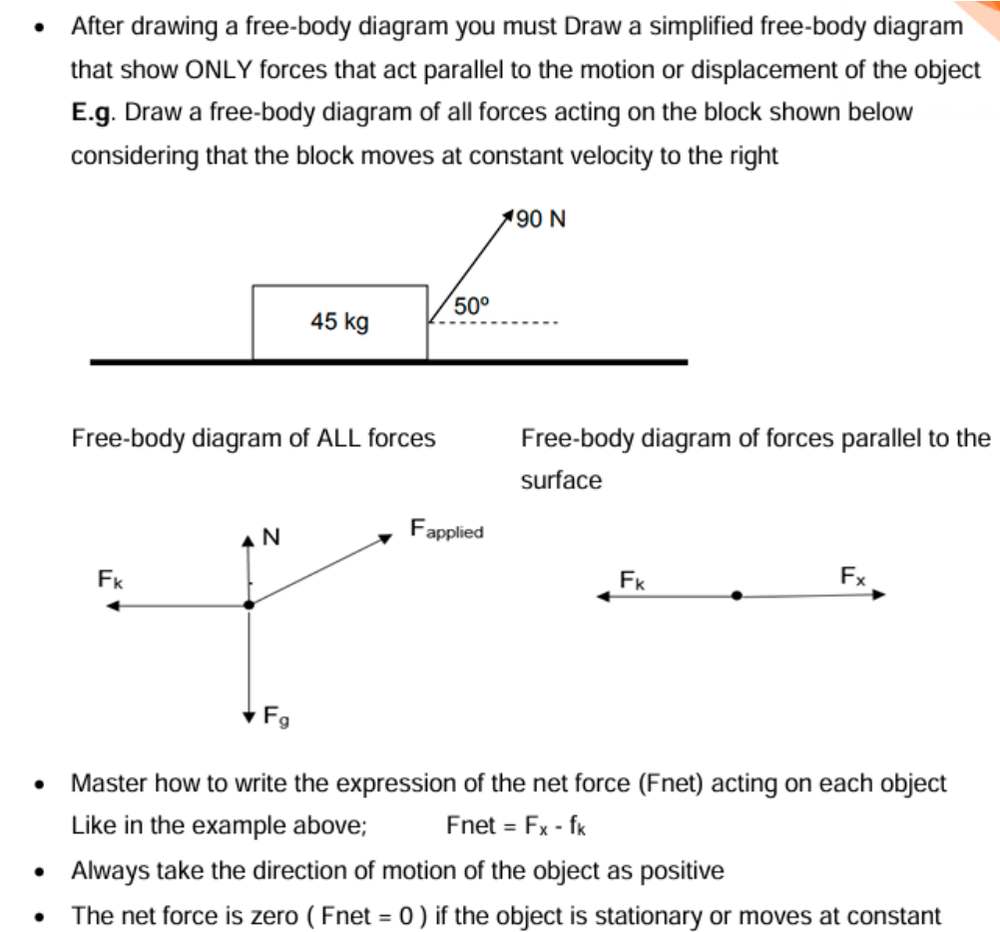
- After drawing a free-body diagram you must Draw a simplified free-body diagram that show ONLY forces that act parallel to the motion or displacement of the object
E.g. Draw a free-body diagram of all forces acting on the block shown below considering that the block moves at constant velocity to the right
- Master how to write the expression of the net force (Fnet) acting on each object
Like in the example above; Fnet = Fx - fk - Always take the direction of motion of the object as positive
- The net force is zero (Fnet = 0) if the object is stationary or moves at constant velocity
- Calculating different forces and the Fnet expression
Gravitational force (weight), Fg or w
The gravitational force is calculated as Fg = m.g
- If the object lies on a Horizontal surface, DO NOT include Fg in the Fnet expression.
- If the object lies on an inclined surface, ALWAYS include Fg// (Fg// = m.g.sinθ) in the Fnet expression.
- If the object moves vertically, up or down, you should include Fg in the Fnet expression
Normal force (N)
- NEVER include the normal force in the expression of Fnet
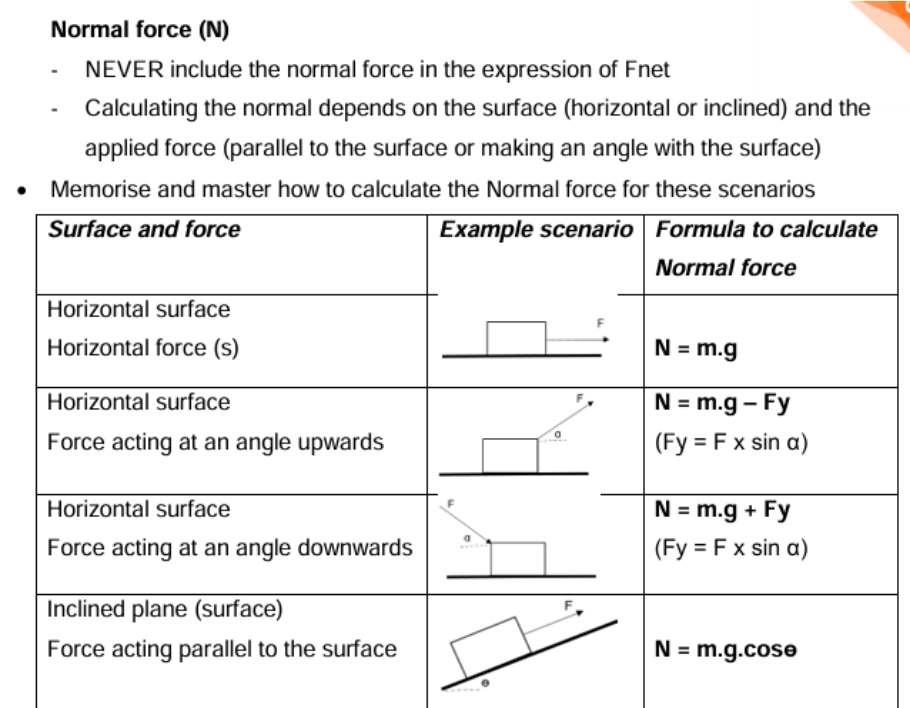
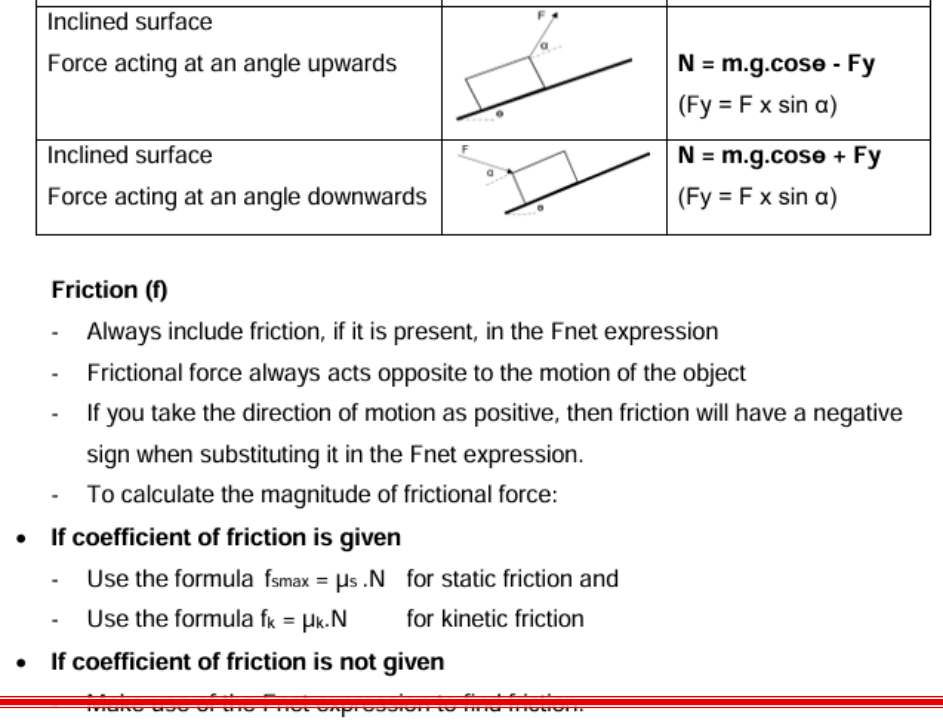
- Calculating the normal depends on the surface (horizontal or inclined) and the applied force (parallel to the surface or making an angle with the surface)
- Memorise and master how to calculate the Normal force for these scenarios
| Surface and force | Formula to calculate Normal force |
|---|---|
| Horizontal surface Horizontal force (s) | N = m.g |
| Horizontal surface Force acting at an angle upwards | N = m.g - Fy (Fy = F x sin α) |
| Horizontal surface Force acting at an angle downwards | N = m.g + Fy (Fy = F x sin α) |
| Inclined plane (surface) Force acting parallel to the surface | N = m.g.cosθ |
| Inclined surface Force acting at an angle upwards | N = m.g.cosθ - Fy (Fy = F x sin α) |
| Inclined surface Force acting at an angle downwards | N = m.g.cosθ + Fy (Fy = F x sin α) |
Friction (f)
- Always include friction, if it is present, in the Fnet expression
- Frictional force always acts opposite to the motion of the object
- If you take the direction of motion as positive, then friction will have a negative sign when substituting it in the Fnet expression.
- To calculate the magnitude of frictional force:
- If coefficient of friction is given
- Use the formula fsmax = μs.N for static friction and
- Use the formula fk = μk.N for kinetic friction
- If coefficient of friction is not given
- Make use of the Fnet expression to find friction.
Tension (T)
- Tension is a force developed in (or transmitted through) a rope or string
- There is no specific formula to calculate the tension as it is considered as an applied force.
- You will generally find tension T in the Fnet expression
- The direction of tension goes to the side of the object where the string is attached. So if the string is attached to the left side of the object, the tension pulls it to the left. If the string is attached at the top of the object, the tension goes upwards
e.g.
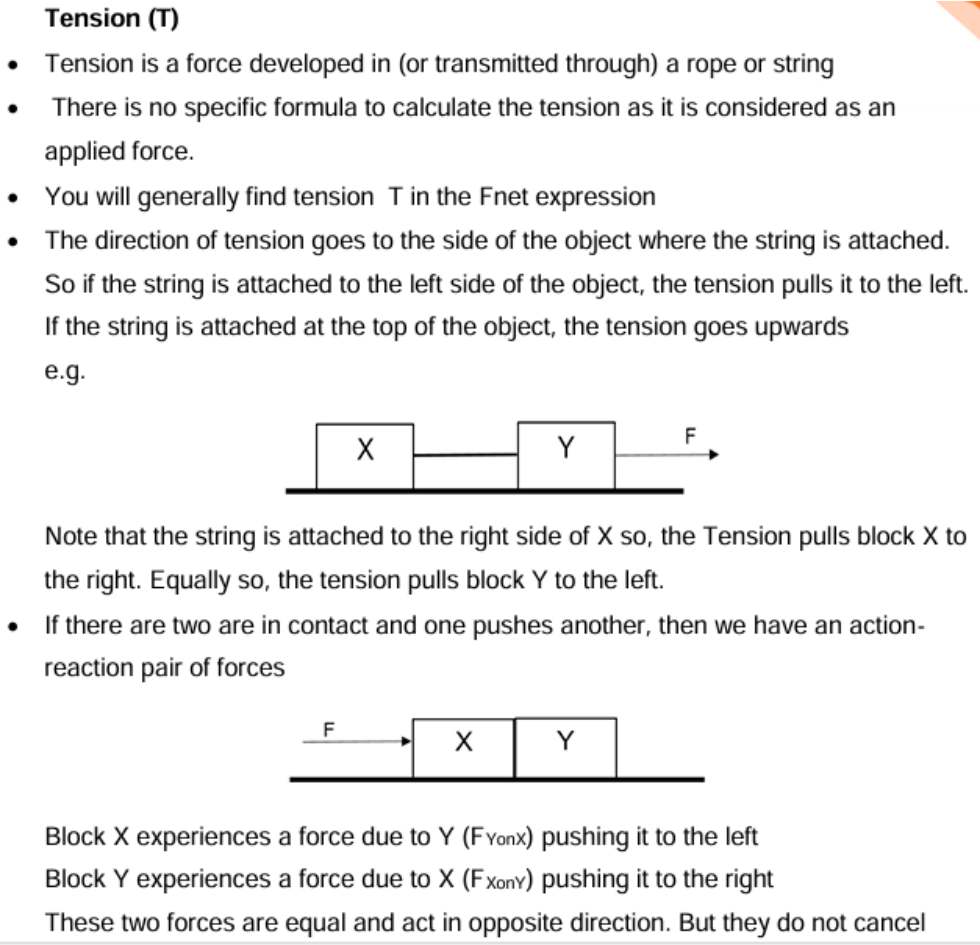
Note that the string is attached to the right side of X so, the Tension pulls block X to the right. Equally so, the tension pulls block Y to the left.
- If there are two are in contact and one pushes another, then we have an action-reaction pair of forces
Block X experiences a force due to Y (FYonX) pushing it to the left
Block Y experiences a force due to X (FXonY) pushing it to the right
These two forces are equal and act in opposite direction. But they do not cancel each other because they act on different objects.
In calculations, treat them the same way you treated Tension
Applied force (F)
- The applied force must always be included in the Fnet expression
- If the applied force acts at an angle α relative to the surface, then only the component of the force parallel to the surface (Horizontal component), Fx, must be included in the Fnet expression.
This component is calculated as Fx = F cos α
Calculations involving Newton's laws
- Draw a free body diagram of ALL forces for each object (Sure case marks)
- Draw a free body diagram showing ONLY forces acting parallel to the motion/surface
- Take the direction of motion as positive
- Write the Fnet expression for each object using vector sum of forces (Fnet = ΣF)
- Write the formula Fnet = m.a (a sure case 1 mark)
- Equate the two expressions for Fnet
Σ F = m.a - If there is only ONE unknown in the equation, solve for it.
- If there are two unknowns, a and T, in both equations then solve the simultaneous equations.
Newton's law of universal gravitation
- Memorise the law
- Use the formula F = G.m1.m2/r2
- Other formulae to use under this topic are g = G.M/r2 and Fg = m.g
| Task | Marks |
|---|---|
| Define one of the forces | 2 marks |
| Formula for calculating the force | 1 mark |
| Draw a free body diagram | 3 marks (minimum) |
| State one of Newton's laws | 2 marks |
| Use of formula Fnet = m.a | 1 mark |
| Use of formula F = G.m1.m2/r2 | 1 mark |
Definitions to know
Say each one before you open it. These are the accepted exam wordings.
Normal force
The force or the component of a force which a surface exerts on an object with which it is in contact, and which is perpendicular to the surface.
Frictional force
The force that opposes the motion of an object and which acts parallel to the surface.
Static frictional force
The force that opposes the tendency of motion of a stationary object relative to a surface.
Kinetic frictional force
The force that opposes the motion of a moving object relative to a surface.
Newton's first law of motion
A body will remain in its state of rest or motion at constant velocity unless a non-zero resultant/net force acts on it.
Newton's second law of motion
When a resultant/net force acts on an object, the object will accelerate in the direction of the force at an acceleration directly proportional to the force and inversely proportional to the mass of the object.
Newton's second law in terms of momentum
The net (or resultant) force acting on an object is equal to the rate of change of momentum of the object (in the direction of the net force).
Newton's third law of motion
When object A exerts a force on object B, object B simultaneously exerts an oppositely directed force of equal magnitude on object A.
Newton's law of universal gravitation
Every particle with mass in the universe attracts every other particle with mass with a force which is directly proportional to the product of their masses and inversely proportional to the square of the distance between their centres.
Question 3Vertical projectile motion
Vertical projectile motion
- Memorise and master the following terms and aspect:
| 1 | Define Free fall | Equations of motion |
| 2 | Define Projectile | Equations of motion |
| 3 | Magnitude and direction of acceleration | 9,8 m·s-2 Downwards |
Equations of motion
- vf = vi + aΔt
- vf2 = vi2 + 2aΔy
- Δy = viΔt + ½aΔt2
- Δy = ((vi + vf)/2) Δt
- Remember to use the formula Δx = v·Δt if the motion of an object moving at a constant velocity is involved. The object can be a Hot-air balloon, a Helicopter, a rocket…
- Note that there are only five variables (terms) to deal with for this topic:
- Initial velocity: vi (vector quantity)
- Final velocity: vf (vector quantity)
- Displacement: Δx (vector quantity)
- Acceleration: a (vector quantity)
- Time interval: Δt (scalar quantity)
- Notice that each equation has got FOUR terms, and the value of acceleration a, that is 9,8 m·s-2, is known (Constant). So practically three terms to focus on. The question statement will provide information about 2 terms and ask you to find the third one (the unknown).
- Always consider two points (positions) before attempting any calculation: A starting point and an end point for the object's motion. This must be informed by the question you are about to answer.
The velocity at the starting point is the initial velocity and the velocity at the end point is the final velocity.
The displacement Δx is the length between the starting point and the end point. Ignore the path taken by the object to move from start to end.
So between the two positions, play with the variables vi, vf, Δx and Δt to select a suitable formula and solve the problem. - The choice of direction is very CRITICAL for Vertical projectile motion. The choice of direction imposes the SIGN of acceleration a (+9,8 or −9,8).
So if you take UPWARDS as positive, the sign of acceleration will be NEGATIVE (−9,8) in ALL your calculations, REGARDLESS of whether the object is moving upwards or downwards. Equally so, if downwards is taken as positive, acceleration will be positive in all calculations. - Master these signs allocation after choosing the direction: Stick to only ONE
| IF UPWARDS IS TAKEN AS POSITIVE | IF DOWNWARDS IS TAKEN AS POSITIVE |
|---|---|
| Acceleration a, upwards or downwards gets a negative sign (a = −9,8) | Acceleration a, upwards or downwards gets a positive sign (a = +9,8) |
| Velocity (vi or vf) upwards gets a positive sign | Velocity (vi or vf) upwards gets a negative sign |
| Velocity (vi or vf) downwards gets a negative | Velocity (vi or vf) downwards gets a positive sign |
| Height above the starting point (Δx) gets a positive sign | Height above the starting point (Δx) gets a negative sign |
| Height below the starting point (Δx) gets a negative sign | Height below the starting point (Δx) gets a positive sign |
| Time interval (Δt) will always be positive | Time interval (Δt) will always be positive |
- Remember that the mass of the object is not necessary for equations of motion. Note that if the mass of the object is given the possibility is that there would be integration of momentum (p = m·v), change in momentum (Δp = m(vf − vi)) or impulse/Newton's second law in terms of momentum (Fnet·Δt = Δp) involved.
- If two objects are given, the first thing is to identify which quantities (vi, vf, Δx or Δt) are the same for both objects.
- Get familiar and master all possible scenarios about Vertical projectile motion.
Drawing or interpreting graphs of motion of a projectile
Position - time graph
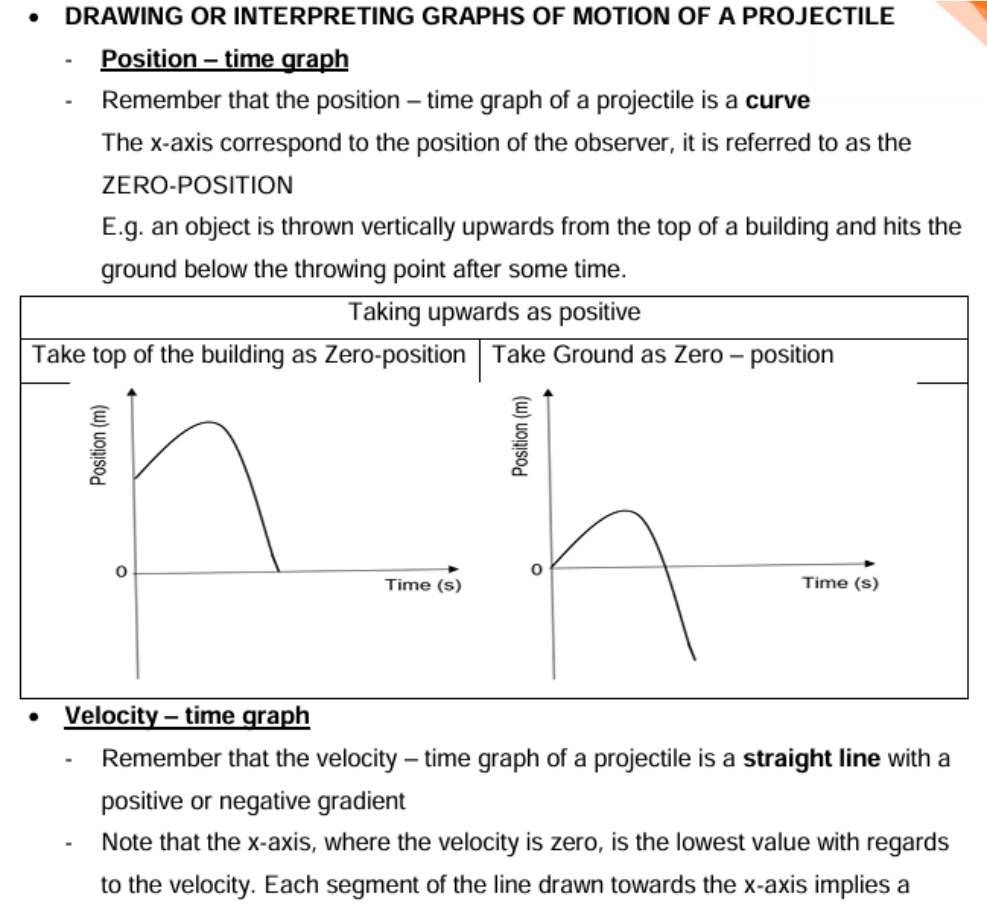
- Remember that the position - time graph of a projectile is a curve.
The x-axis corresponds to the position of the observer; it is referred to as the ZERO-POSITION.
E.g. an object is thrown vertically upwards from the top of a building and hits the ground below the throwing point after some time.
| Taking upwards as positive | |
|---|---|
| Take top of the building as Zero-position | Take Ground as Zero - position |
Velocity - time graph
- Remember that the velocity - time graph of a projectile is a straight line with a positive or negative gradient.
- Note that the x-axis, where the velocity is zero, is the lowest value with regards to the velocity. Each segment of the line drawn towards the x-axis implies a decrease in velocity, regardless of whether the line is above or below the x-axis. Any segment of line drawn away from the x-axis implies an increase in velocity.
E.g. Two graphs that represent the same scenario
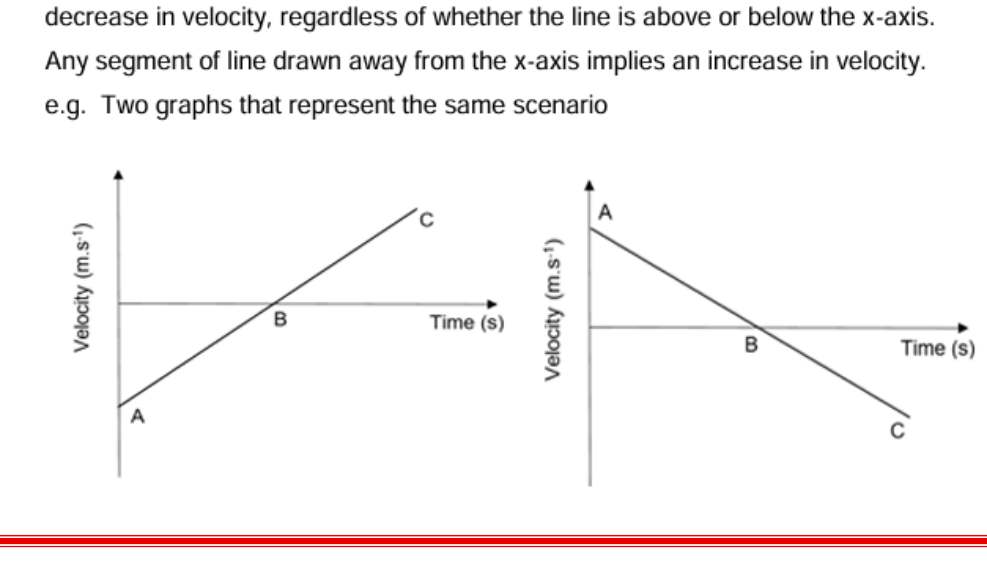
- Segment A - B, the line is drawn directed TOWARDS the x - axis. So from A to B, the velocity DECREASES.
Segment B - C, the line is drawn directed AWAY FROM the x - axis. So from B to C, the velocity INCREASES. - The gradient of velocity - time graph represents the acceleration.
- The area between the line and the x - axis represents the displacement.
Acceleration - time graph
- Remember that the acceleration of a projectile is constant.
- The acceleration - time graph is a straight horizontal line.
- The horizontal line is drawn above the x-axis from +9,8 if Downwards was taken as positive.
- The horizontal line is drawn below the x-axis from −9,8 if Upwards was taken as positive.
Marks allocation
| Define Free fall or projectile | 2 marks |
| Formula to calculate time | 1 mark |
| Formula to calculate velocity | 1 mark |
| Formula to calculate displacement | 1 mark |
| Drawing a graph (shape or starting point) Or interpreting graph (reading value from graph) | 1 mark |
Definitions to know
Say each one before you open it. These are the accepted exam wordings.
Free fall
Motion during which the only force acting is the gravitational force.
Projectile
An object upon which the only force acting is the force of gravity.
Acceleration of a projectile
The acceleration due to gravity: 9,8 m·s⁻² downwards. It is constant, whether the object moves up or down, and is independent of the object's mass.
Question 4Momentum and impulse
From the pack: Newton's laws tip page
| Concept | Associated formula |
|---|---|
| State Newton's second law in terms of momentum | Fnet = Δp / Δt |
Tip sheet written for this guide.
Key terms: learn these word for word
| Term | Definition |
|---|---|
| Momentum | The product of an object's mass and its velocity. |
| Newton's second law in terms of momentum | The net (resultant) force acting on an object is equal to the rate of change of momentum of the object. |
| Impulse | The product of the net force acting on an object and the time the net force acts on the object. |
| Principle of conservation of linear momentum | The total linear momentum of an isolated system remains constant (is conserved). |
| Isolated (closed) system | A system on which the net external force is zero. |
| Elastic collision | A collision in which both total momentum and total kinetic energy are conserved. |
| Inelastic collision | A collision in which only total momentum is conserved (total kinetic energy is not conserved). |
Formulas
- Momentum: p = mv (vector, unit kg·m·s-1)
- Change in momentum: Δp = mvf − mvi = m(vf − vi)
- Impulse: FnetΔt = Δp = mvf − mvi (unit N·s, which equals kg·m·s-1)
- Conservation of momentum: Σpi = Σpf, e.g. m1v1i + m2v2i = m1v1f + m2v2f
- Objects that stick together: m1v1i + m2v2i = (m1 + m2)vf
- Explosion from rest: 0 = m1v1f + m2v2f
- Elastic check: ΣEk,before = ½m1v1i2 + ½m2v2i2 compared with ΣEk,after
Marks-earning tips
- Write down your positive direction first (e.g. "Take to the right as positive"). Velocities in the opposite direction are then negative.
- Momentum and impulse are vectors: give magnitude AND direction when the question asks for momentum, velocity or impulse.
- Every definition of the conservation principle must say "in an isolated (closed) system", or you lose that mark. The system mark is only given if it is used together with momentum.
- Start every calculation with the formula: Σpi = Σpf or FnetΔt = Δp. The formula line earns a mark.
- Elastic or inelastic: calculate the TOTAL Ek before and the TOTAL Ek after, then conclude: "inelastic, because kinetic energy is not conserved". A conclusion without both values earns nothing.
- A rebound changes the sign of the velocity: Δp = m(vf − vi) with vf and vi of opposite sign, so the two speeds add.
- Convert units first: g to kg (÷ 1 000), km·h-1 to m·s-1 (÷ 3,6).
- Safety features (crumple zones, airbags, seatbelts): they increase the time of the collision, and because Fnet = Δp/Δt, the net force on the passenger is smaller for the same change in momentum.
- In a collision the two objects exert equal and opposite forces on each other (Newton's third law), so they receive equal and opposite impulses.
Definitions to know
Say each one before you open it. These are the accepted exam wordings.
Momentum
The product of an object's mass and its velocity.
Newton's second law in terms of momentum
The net (or resultant) force acting on an object is equal to the rate of change of momentum of the object.
Impulse
The product of the net force acting on an object and the time the net force acts on the object.
Principle of conservation of linear momentum
The total linear momentum of an isolated system remains constant (is conserved).
Isolated system
A system on which the net external force is zero.
Elastic collision
A collision in which both total momentum and total kinetic energy are conserved.
Inelastic collision
A collision in which only total momentum is conserved (total kinetic energy is not conserved).
Work-energy theorem
The net work done on an object is equal to the change in the object's kinetic energy.
Question 5Work, energy and power
Terms and concepts to memorise and master
| # | Term | Formula |
|---|---|---|
| 1 | Define Work done | W = FΔx cosθ |
| 2 | State the work - energy theorem | Wnet = ΔEk |
| 3 | Define Conservative force | Wc = - ΔEp |
| 4 | Define Non - conservative force | Wnc = ΔEp + ΔEk |
| 5 | Define Gravitational potential energy | Ep = mgh |
| 6 | Define kinetic energy | Ek = ½ mv2 |
| 7 | Define Mechanical energy | EM = Ep + Ek |
| 8 | State the law of conservation of mechanical energy | Ep + Ek = Ep + Ek |
| 9 | Define Power | P = W/Δt / Pavg = Fvavg |
- Remember that Work is done on an object by a force acting parallel or at an angle θ to the displacement of the object
W = FΔx cosθ - Always start by drawing a free-body diagram of ALL the forces acting on the object
Remember the following aspects
- θ is the angle between the force and the displacement
- Work done by Normal is always Zero (θ is 90°)
- Work done by friction is always negative (θ is 180°)
- Work done can be positive, negative or zero
The net work done (Wnet) can be calculated in three different ways
- Wnet = WF1 + WF2 + …. (sum of work done by each force acting on the object)
- Wnet = FnetΔx cosθ
- Wnet = ½ mvf2 - ½ mvi2
- ALWAYS LINK any two of these formulae, depending on the information given in the statement and what you need to calculate
- The net work done is zero (Wnet = 0) if the object is stationary or move at a constant speed.
- If friction is the only non-conservative force acting on the object, then Wnc = Wf
- Use these formulae Wnc = ΔEp + ΔEk and mgh + ½ mv2 = mgh + ½ mv2 mostly when HEIGHT is involved, i.e. if the object moves vertically (up or down) or the object is on an inclined surface
- Use this formula mghi + ½ mvi2 = mghf + ½ mvf2 only when there is NO friction or any other applied force and also when height is involved
- Remember that in the formula P = W/Δt, W represents the work done by the force that develops the power
- Use the formula Pavg = Fvavg if the speed of the object is given instead of time
Mark allocation
| Item | Marks |
|---|---|
| Define one of the terms | 2 marks |
| Formula to calculate that quantity | 1 mark |
| State the law of conservation of Mechanical energy | 2 marks |
| Formula for conservation of mechanical energy | 1 mark |
| State the work - energy theorem | 2 marks |
| Formula for work - energy theorem | 1 mark |
Definitions to know
Say each one before you open it. These are the accepted exam wordings.
Work done
The work done on an object by a constant force F is FΔx cosθ, where F is the magnitude of the force, Δx the magnitude of the displacement and θ the angle between the force and the displacement.
Work-energy theorem
The net/total work done on an object is equal to the change in the object's kinetic energy. OR The work done on an object by a resultant/net force is equal to the change in the object's kinetic energy.
Conservative force
A force for which the work done in moving an object between two points is independent of the path taken.
Non-conservative force
A force for which the work done in moving an object between two points depends on the path taken.
Gravitational potential energy
The energy an object possesses due to its position relative to a reference point.
Kinetic energy
The energy an object possesses as a result of its motion.
Mechanical energy
The sum of gravitational potential energy and kinetic energy.
Law of conservation of mechanical energy
The total mechanical energy in an isolated system remains constant. (A system is isolated when the resultant/net external force acting on the system is zero.)
Power
The rate at which work is done or energy is expended.
Question 6Doppler effect
Doppler effect: terms to memorise and master
| # | Term | Formula / key idea |
|---|---|---|
| 1 | Define Doppler effect | fL = (v ± vL)/(v ± vs) × fs |
| 2 | Explain Redshift | v = f × λ Shift towards lower frequency |
| 3 | Explain Blueshift | f = 1/T Shift towards higher frequency |
| 4 | State applications of Doppler effect |
- Use the Doppler Effect equation with the ± as given. It is the safest way to secure 1 mark.
Tips for choosing formula
Check the number of questions under Doppler Effect.
- If there is only ONE calculation, then the formula to use is fL = (v ± vL)/(v ± vs) × fs
- If there are TWO calculations, the one with MORE marks is the one to use the Doppler Effect formula for. The other calculation, usually for 3 marks, the formula to use is:
- v = f × λ Note that in this formula, v is the speed of sound in air, not the speed of the listener or the source of sound
- f = 1/T
For the formula fL = (v ± vL)/(v ± vs) × fs
- Never use the same sign on both the numerator and the denominator. If + sign is used on the numerator, then − sign goes to the denominator and vice versa.
- If one, between the listener and the source of sound, moves TOWARDS another, the numerator will have the + sign and so obviously the − sign for the denominator. Use the word TOP to remember (TOP for numerator, TO for TOwards and P for Plus sign).
Applications
Memorize the applications of Doppler Effect in medicine and other fields:
- Ultrasound machine: to check the unborn baby for pregnant women
- Doppler flowmeter: to monitor the speed of blood
Redshift and blueshift
Explain Redshift and blueshift in terms of shift in spectral lines.
| Shift | What happens to the lines | Motion |
|---|---|---|
| Redshift | Lines shift towards lower frequencies | MOVING AWAY |
| Blueshift | Lines shift towards higher frequencies | MOVING TOWARDS |
- Remember that Redshift proves to us that the universe is EXPANDING.
Where the marks are
| Task | Marks |
|---|---|
| Define Doppler Effect | 2 marks |
| Formula to calculate frequency or Wavelength | 1 mark |
| Doppler Effect formula | 1 mark |
| Application of Doppler Effect | 1 mark |
Definitions to know
Say each one before you open it. These are the accepted exam wordings.
Doppler effect
The change in frequency (or pitch) of the sound detected by a listener because the sound source and the listener have different velocities relative to the medium of sound propagation.
Red shift
The observed spectral lines of a star (or galaxy) are shifted towards longer wavelengths / lower frequencies (the red end of the spectrum) because the star is moving away from the Earth.
Blue shift
The observed spectral lines of a star are shifted towards shorter wavelengths / higher frequencies (the blue end of the spectrum) because the star is moving towards the Earth.
Frequency
The number of wave pulses (waves) per second, i.e. the number of waves passing a fixed point per second.
Question 7Electrostatics
Memorise and master the following terms
| # | Term | Formula |
|---|---|---|
| 1 | Charge quantisation | Q = n.qe |
| 2 | Conservation of charge | Qnew = (Q1 + Q2)/2 |
| 3 | State Coulomb's law | F = kQ1Q2/r2 |
| 4 | Define Electric field | |
| 5 | Define Electric field at a point | E = F/q or E = kQ/r2 |
- Remember that positively charged object lost electrons and a negatively charged object gained electrons
- Remember that if two charged objects are allowed to touch each other, electrons will move from the object with a smaller electric charge to the object with a greater electric charge
- To calculate the actual charge on each object after separation, use the formula Qnew = (Q1 + Q2)/2 if 2 charged objects are involved or Qnew = (Q1 + Q2 + Q3)/3 if 3 charges are involved and so on
- To calculate the number of electrons transferred
First calculate the difference between the initial charge (before touching) and the final charge (after separation)
Use the formula Q = n.qe to calculate the number of electrons n. This number must always be negative.
- After stating Coulomb's law, use the formula F = kQ1Q2/r2 for the next calculation
- After defining Electric field or Electric field at a point, use the formula E = kQ/r2 in most cases where distance is involved. Otherwise use E = F/q if there is a charge at that point and you have been given or you have previously calculated the force
- Remember that there are only 3 possible shapes for the electric field pattern
| For only ONE charge | For TWO charges | ||
|---|---|---|---|
| Positive charge | Negative charge | Attraction | Repulsion |
| Straight lines radiating outwards from the charge, arrows pointing away from it | Straight lines radiating into the charge, arrows pointing towards it | Lines leave the positive charge and curve into the negative charge, arrows from + to − | Lines leave both positive charges and bend away from each other; no lines cross the space between them |
Marks allocation
- State coulomb's law – 2 marks
- Formula for Coulomb's law – 1 mark
- Define Electric field or Electric field at a point – 2 marks
- Formula for electric field at a point – 1 mark
- Draw electric field pattern – 2 marks
Definitions to know
Say each one before you open it. These are the accepted exam wordings.
Charge quantisation (principle of quantisation of charge)
Every charge in the universe consists of an integer multiple of the charge on one electron, i.e. Q = nqe (qe = 1,6 × 10⁻¹⁹ C).
Conservation of charge (principle of conservation of charge)
The net charge of an isolated system remains constant during any physical process.
Coulomb's law
The magnitude of the electrostatic force exerted by one point charge (Q1) on another point charge (Q2) is directly proportional to the product of the magnitudes of the charges and inversely proportional to the square of the distance (r) between them.
Electric field
A region of space in which an electric charge experiences a force.
Electric field at a point
The electrostatic force experienced per unit positive charge placed at that point.
Question 8Electric circuits
Memorise and master the following terms:
| 1 | Define emf (Electromotive force) | Maximum V = W/q |
|---|---|---|
| 2 | State Ohm's law | V = I.R |
| 3 | Define Internal resistance | ε = I (R + r) |
| 4 | Define Power | P=VI or P=I2R or P = V2/R or P = W/Δt |
Properties of series circuits
- Total resistance : RT = R1 + R2 + …
The total resistance increases as the number of resistors increases - Current is the same through resistors in series: IT = I1 = I2 = …
- Voltage is divided among resistors in series: VT = V1 + V2 + …
Properties of parallel circuits
- Total resistance: 1/RP = 1/R1 + 1/R2 + …
The total resistance decreases as the number of resistors increases - Current is divided among resistors in parallel: IT= I1+I2+…
- Voltage is the same across resistors in parallel: VT=V1=V2=…
Remember
- Remember the relationship between Current and resistance
If the resistance increases the current decreases and vice versa - If power is given, make use of the applicable formula for power
P=VI, P=I2R, P = V2/R , or P = W/Δt in order to get either I, V or R - For any resistor, always consider these 3 variables I, V and R
If you are given 2 of them, calculate the unknown.
Make use of the formula I = V/R in most of your calculations - All resistors in an electric circuit are related in some sort
- It is either they have the same current or same voltage or
- They share the current or the voltage
- If you are asked to calculate the value of the internal resistance, use the formula
VLost=I.r or ε = I (R + r) - If you are asked to calculate the emf of the cell/battery, use the formula
ε = I (R + r). Anyway, that is the only formula with emf from your data sheet.
Interpretation of basic graphs
| Ohm's law | |
|---|---|
| V (V) against I (A) | I (A) against V (V) |
| Straight line with positive gradient V is directly proportional to I The gradient of the graph represents the resistance |
Straight line with positive gradient I is directly proportional to V The gradient of the graph represents the INVERSE of the resistance |
| Relationship between I and V in the presence of Internal resistance | |
| V (V) against I (A) | Straight line with negative gradient External Voltage decreases as current increases The GRADIENT of the graph represents the internal resistance The y-intercept represents the emf |
Mark allocation
| State ohm's law | 2 marks |
| Calculating total resistance | 1 mark |
| Formula for Ohm's law | 1 mark |
| Define emf/Internal resistance/power | 2 marks |
| Formula for emf or internal resistance | 1 mark |
| Formula for power | 1 marks |
Definitions to know
Say each one before you open it. These are the accepted exam wordings.
Emf (electromotive force)
The maximum energy provided (work done) by a battery per coulomb (unit charge) passing through it.
Ohm's law
The potential difference across a conductor is directly proportional to the current in the conductor at constant temperature.
Internal resistance
The opposition to the flow of charge within a battery.
Power
The rate at which electrical energy is converted in an electric circuit (the rate at which work is done). P = W/Δt
Question 9Electrodynamics
Question 9: Electrodynamics
- Know, memorise and master the following terms.
| # | Term | Formula |
|---|---|---|
| 1 | State energy conversion in electric Motor | |
| 2 | State energy conversion in Generators | |
| 3 | Distinguish between AC and DC machine | |
| 4 | State the operational principle for Motors | |
| 5 | State the operational principle for generators | |
| 6 | Define rms current | Irms = Imax/√2 |
| 7 | Define rms voltage | Vrms = Vmax/√2 |
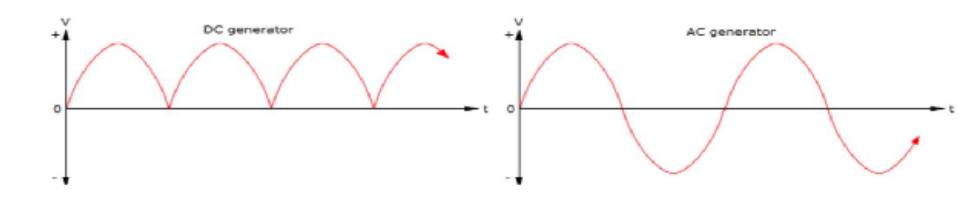
- Distinguish between a DC or an AC machine from given sketch diagram.
- List all components of an electric machine
- Graphs of output voltage or current of an AC generator
- Be able to perform calculations involving average Power
Pavg = Vrms·Irms, Pavg = Irms2R, Pavg = Vrms2/R
- Calculations are similar to the ohm's law calculations.
| Question type | Marks |
|---|---|
| State energy conversion or principle of operation | 2 marks |
| Identify/name components of a machine | 1 mark |
| Distinguish between AC and DC machine | 1 mark |
| Define rms current or voltage | 2 marks |
| Formula Vrms or Irms in terms of Vmax or Imax and Pavg | 1 mark |
| State at least one advantage of AC over DC | 1 marks |
Definitions to know
Say each one before you open it. These are the accepted exam wordings.
Energy conversion in an electric motor
Electrical energy is converted to mechanical (kinetic) energy.
Energy conversion in a generator
Mechanical (kinetic) energy is converted to electrical energy.
AC machine vs DC machine
An AC generator/motor has slip rings; a DC generator/motor has a split-ring commutator.
Operational principle of a motor (motor effect)
A current-carrying conductor (coil) placed in a magnetic field experiences a force, which produces a torque that makes the coil rotate.
Operational principle of a generator (electromagnetic induction)
An emf is induced in a coil when the magnetic flux linked with the coil changes (Faraday's Law of electromagnetic induction).
rms current
The rms value of AC current is the DC current which dissipates the same amount of energy (power) as the AC. Irms = Imax/√2
rms voltage
The rms value of AC potential difference is the DC potential difference which dissipates the same amount of energy (power) as the AC. Vrms = Vmax/√2
Question 10Photoelectric effect
Photoelectric effect
- Know, memorise and master the following terms
| 1 | Define Photoelectric Effect | E = W0 + Ekmax |
| 2 | Define Photon | E = hf |
| 3 | Define Photoelectron | Ekmax = ½ mv2 |
| 4 | Define Work function | W0 = hf0 |
| 5 | Define Threshold frequency | f0 = c / λ0 |
| 6 | Explain line Absorption spectrum | |
| 7 | Explain line Emission spectrum |
- State the dual-nature of light : Wave and particle
- Remember the order arrangement of EM radiations
- In order of increasing frequency
Radiowaves - Microwaves - Infrared - Visible light - Ultra violet - X-ray - Gamma rays (Remember RaMIVUX G)
- In order of increasing frequency
- Remember the arrangement order of colours in a spectrum
- Order of increasing frequency
Red - Orange - Yellow - Green - Blue - Indigo - Violet. (Remember ROY GBIV)
- Order of increasing frequency
- Remember that Photoelectric effect is a process, and as such it has three stages. The three stages are interdependent:
You make use of information in stage 1 and 2 to find the unknown in stage 3. Similarly you use information in stage 2 and 3 to get information in 1. Or finally use information in 1 and 3 to get information in 2. - Summary of what each stage represent and related definitions and formulae.
From the Photoelectric Effect equation E = W0 + Ekmax
| Incident light (Photon) | Metal | Photoelectron |
|---|---|---|
| E | W0 | Ekmax |
| Photon Energy Frequency Wavelength | Work function Threshold frequency Threshold wavelength | Kinetic energy Speed |
- Tips for choosing formula
Check the number of questions under Photoelectric Effect- If there is only ONE calculation, then the formula to use is E = W0 + Ekmax
- If there are TWO calculations, the one with MORE marks is the one to use the Photoelectric Effect equation (E = W0 + Ekmax) for.
- The other calculation, usually for 3 marks, use the applicable formula from the list below. The choice of formula is informed by the question and the data available
- c = f × λ or c = f0 × λ0
- f = 1/T
- E = hf or W0 = hf0
- Ekmax = ½ mv2
- Photocell
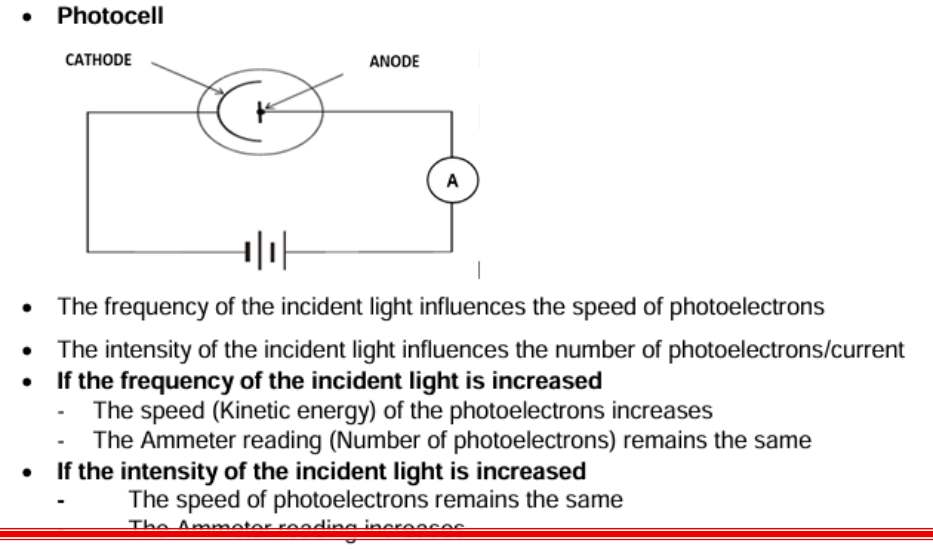
- The frequency of the incident light influences the speed of photoelectrons
- The intensity of the incident light influences the number of photoelectrons/current
- If the frequency of the incident light is increased
- The speed (Kinetic energy) of the photoelectrons increases
- The Ammeter reading (Number of photoelectrons) remains the same
- If the intensity of the incident light is increased
- The speed of photoelectrons remains the same
- The Ammeter reading increases
- Interpretation of a basic graph under photoelectric effect
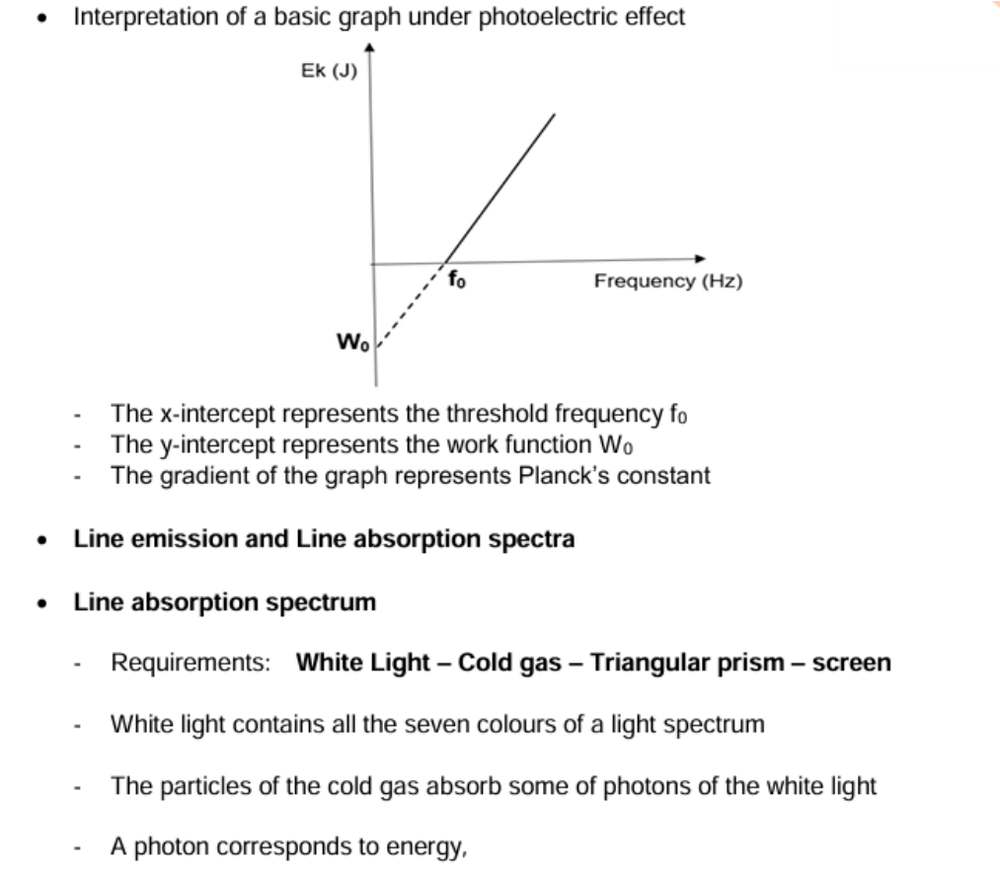
- The x-intercept represents the threshold frequency f0
- The y-intercept represents the work function W0
- The gradient of the graph represents Planck’s constant
Line emission and Line absorption spectra
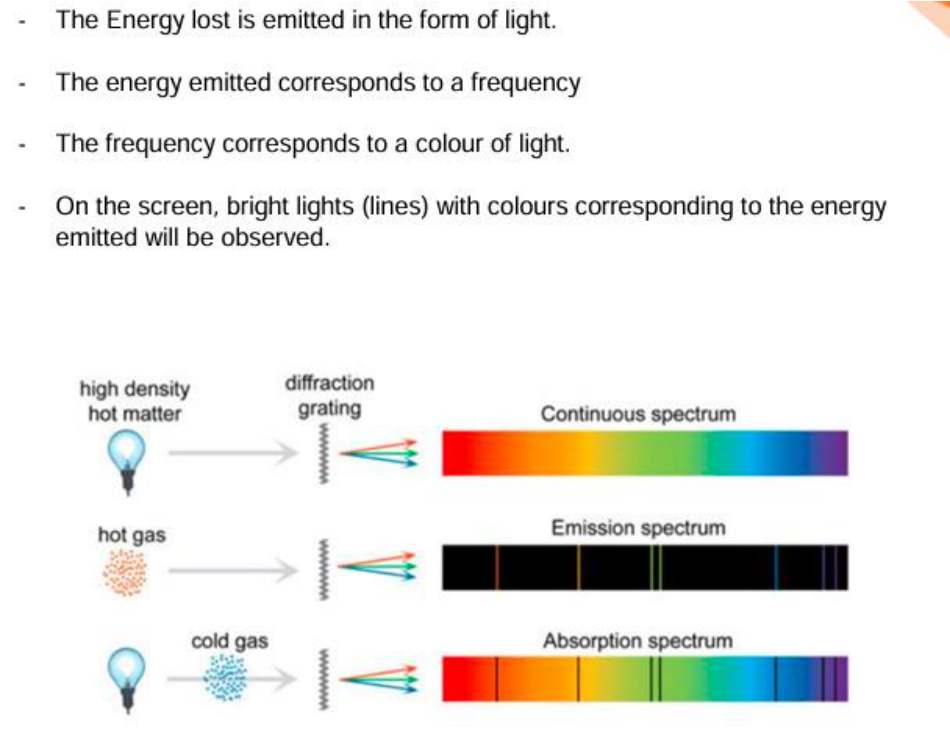
Line absorption spectrum
- Requirements: White Light - Cold gas - Triangular prism - screen
- White light contains all the seven colours of a light spectrum
- The particles of the cold gas absorb some of photons of the white light
- A photon corresponds to energy,
- Energy corresponds to frequency and
- Frequency corresponds to colour.
- These colours will be missing on the screen and dark lines will be seen throughout the spectrum
Line emission spectrum
- Requirements:
(Other source of energy) - Hot gas - Triangular prism - screen, - The particles of a HOT gas absorb energy (from the other source of energy) to move to a higher energy level.
- Particles fall back to their initial energy level by losing energy.
- The Energy lost is emitted in the form of light.
- The energy emitted corresponds to a frequency
- The frequency corresponds to a colour of light.
- On the screen, bright lights (lines) with colours corresponding to the energy emitted will be observed.
Marks allocation
| Define one of the terms | 2 marks |
| Use formula to calculate E, f, λ, W0, f0, Ekmax or v | 1 mark |
| Use Photoelectric Effect equation | 1 mark |
| State the effect of frequency or intensity on photoelectrons | 1 marks |
Definitions to know
Say each one before you open it. These are the accepted exam wordings.
Photoelectric effect
The process whereby electrons are ejected from a metal surface when light of suitable frequency is incident on that surface.
Photon
A quantum (discrete packet) of light energy, i.e. of electromagnetic radiation, with energy E = hf.
Photoelectron
An electron that is emitted (ejected) from the surface of a metal when light of suitable frequency is incident on that surface.
Work function (W₀)
The minimum energy that an electron in the metal needs to be emitted from the metal surface.
Threshold frequency (f₀)
The minimum frequency of light needed to emit electrons from the surface of a certain metal.
Line absorption spectrum
A continuous spectrum with dark lines. When white light passes through a cold gas, the atoms absorb photons of certain specific frequencies (energies) as their electrons move to higher energy levels. Those frequencies are missing from the spectrum and appear as dark lines.
Line emission spectrum
A series of bright coloured lines on a dark background. When atoms of a hot (excited) gas return from higher to lower energy levels, they emit photons of certain specific frequencies (energies); each frequency appears as a bright line of a particular colour.
Your results
What to revise
Targeted flashcards from your mistakes
1. Multiple choice
2. Give the term
Type the one word or term being described, then press Check.
3. Match Column A with Column B
| Column A | Your answer |
|---|
4. Flashcards
Click a card to flip it. Not scored, use it to drill the key terms.
Attempt history
Saved in this browser only, on this computer. The Topic column shows which filter was active for that attempt.
Exam paper and memorandum
Answer every question in the box, press Check for instant feedback, then press Show correct answer to see the official memo. The memo unlocks once you have checked.
Cognitive demand overview
Tags are inferred from question wording and required operations. They are not official DBE classifications.
Offline Physics drawing lab
Choose a prompt, then click or tap and drag from the object to draw a labelled arrow. Use the keyboard by focusing the canvas, pressing Enter to place the start, using arrow keys, then pressing Enter again.
Selected label: Fg. Drag from the centre object outwards.
Weakness analysis and next steps
Your answers and mistake history stay in this browser. Nothing is uploaded.
Provenance
- Source material: notes, questions, images, mark allocations and answer-matching content preserved from the source revision guide.
- Official memo text: shown unchanged where the source identifies a memorandum.
- Generated scaffolding: staged hints, follow-up suggestions, teacher guidance and model drawing guidance added for this build.
- Inferred cognitive tags: heuristic classifications, clearly labelled and not official DBE classifications.